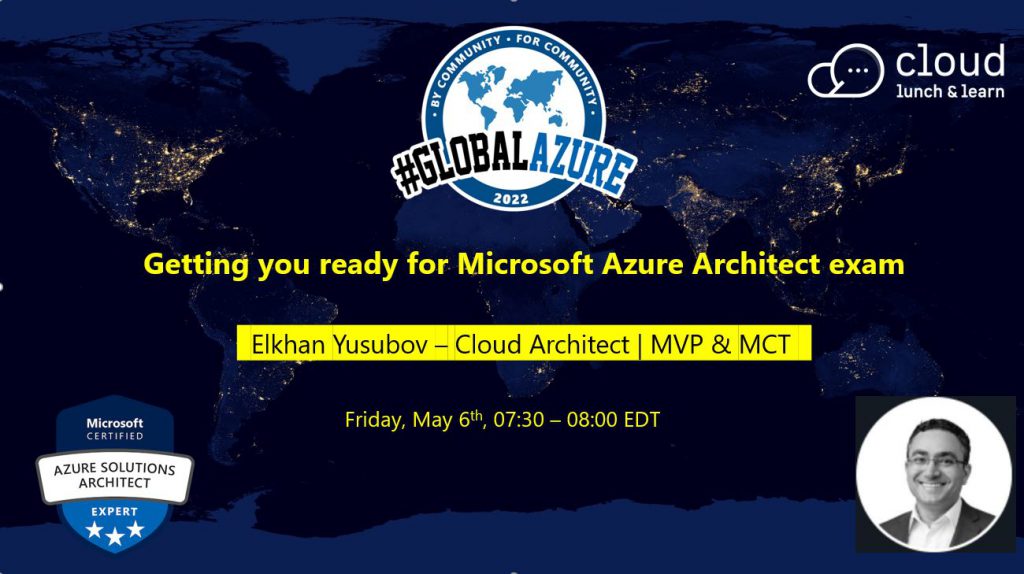
In this session, I focused on a number of changes in Microsoft Azure Architect exam, as it might be troublesome to get ready for it with all the digital distractions around us.
However, in this lightning talk, I shared bits and tips on how to focus on the AZ-305 Designing Microsoft Azure Infrastructure Solutions exam objectives and help you to prepare for a big day.
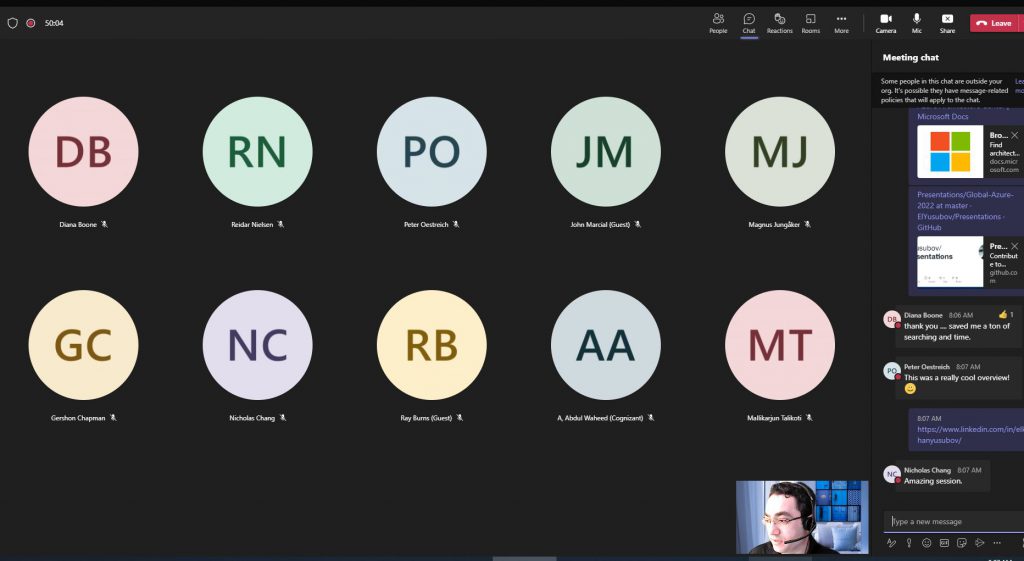
A screenshot from the participants comments
As part of this presentation, I have shared free, official and community learning resources that will boost your knowledge, and hopefully help you pass this important exam with confidence.
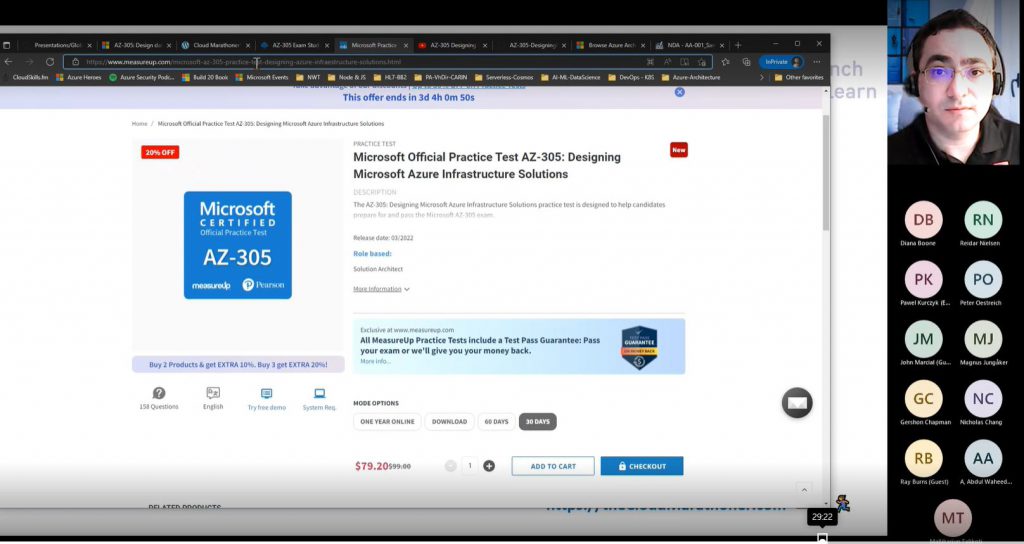
A screenshot of an official practice exam reference
If you missed this session, no worries, you are covered, as this session was recorded. It is freely availiable on the #cloudmarathoner ⏯ 🖐 YouTube channel here.
The slides and as well as links to the recommended resources are posted on my 🖐 👨💻 GitHub repo here.
Please, feel free to check up this GitHub repo, share & fork it as you like 👍
The monitoring is a skill and not a full-time job. In today’s world of cloud-based architectures that are implemented through DevOps projects, developers, SREs, and operations staff must collectively define an effective cloud monitoring and logging strategy. This strategy should focus on identifying when service-level objectives (SLOs) and service-level agreements (SLAs) are not being met, likely negatively affecting the user experience.
Cloud monitoring is a method of reviewing, observing, and managing the operational workflow in a cloud-based IT infrastructure. Manual or automated management techniques confirm the availability and performance of websites, servers, applications, and other cloud infrastructure.
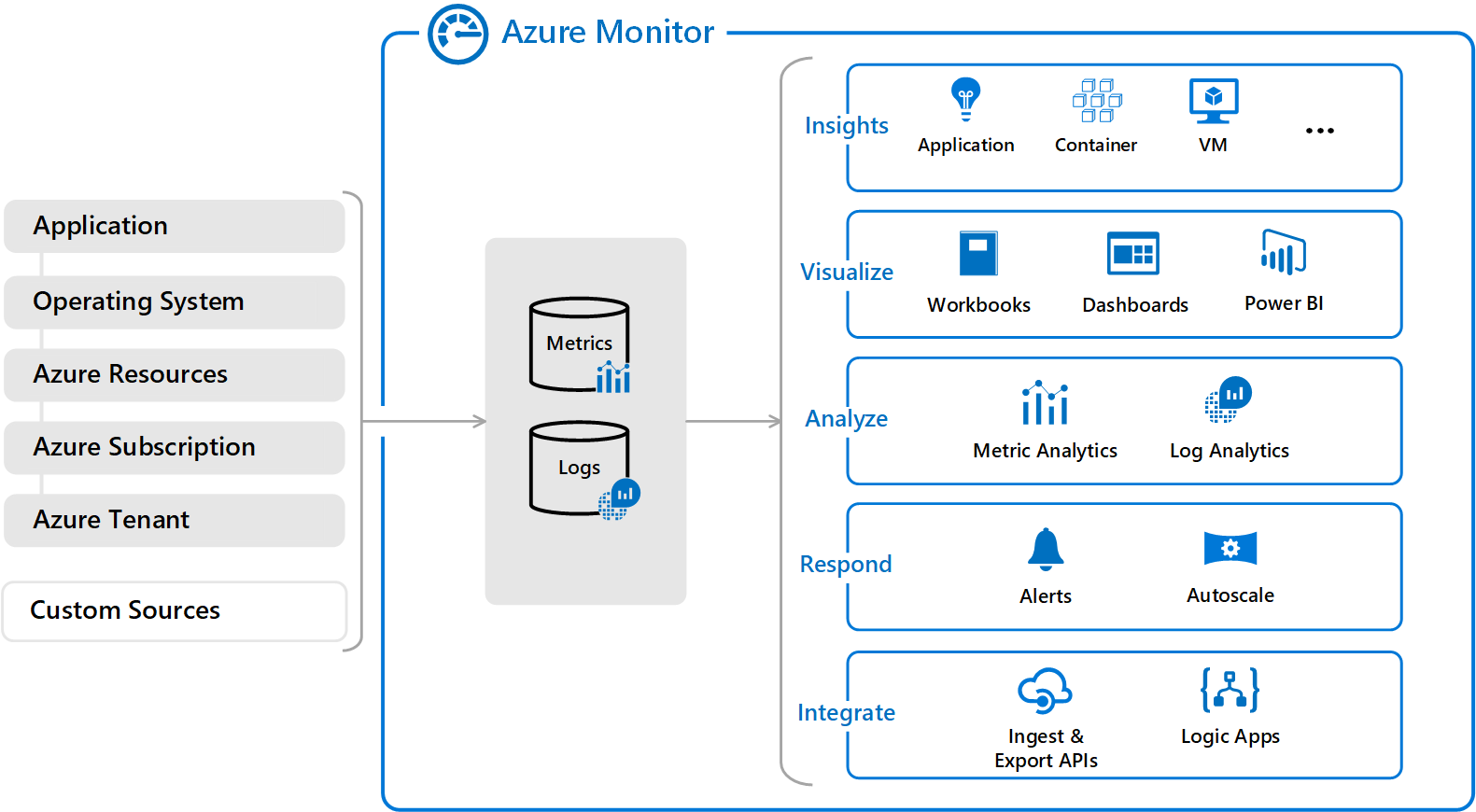
Azure Monitor helps you maximize the availability and performance of your applications and services. It delivers a comprehensive solution for collecting, analyzing, and acting on telemetry from your cloud and on-premises environments. This information helps you understand how your applications are performing and proactively identify issues affecting them and the resources they depend on.
Microsoft docs
The Azure Monitor collects the following sets of data:
This is the continuation (Part 2/12) of blog post series to help you get ready for the latest AZ-305 exam. As title says – our focus will be on understanding and designing Authentication and Authorization Solutions in Microsoft Azure.
Feel free to check the previous post (Part 1/12) if you did not look into it yet 🙂
Table of content (blog series)
*** Design Identity, Governance, and Monitoring Solutions ***
To put it in plain English language, authentication is the process of verifying who someone is, where as authorization is the process of verifying what specific applications, files, and data a user has access to.
To relate these concepts to a real-world scenarious, you may think about your airport access and on-boarding to the plane experience. Thus, when you go through the security in an airport, you are required to show your ID to authenticate your identity. Then, you proceed and arrive at the gate, you present your boarding pass to the flight attendant, so they can authorize you to board your flight and allow access to your assigned seat.
WHAT YOU CAN DO WITH Authentication and Authorization?
The Authentication sometimes shortened to ‘AuthN’. The Microsoft identity platform uses the OpenID Connect protocol for handling authentication. On the other hand, Authorization sometimes shortened to ‘AuthZ‘. The Microsoft identity platform uses the OAuth 2.0 protocol for handling authorization.
In Microsoft Azure your authentication and authorization is delegated to Azure Active Directory (Azure AD). By using this centralized identity provider you can enable following secure workflows for your business:
Conditional Access policies – that require a user to be in a specific location.
Enabling a user to sign in once and then be automatically signed in to all of the web apps that share the same centralized directory. This capability is called single sign-on (SSO).
Part 2: Designing Authentication and Authorization solutions
The references below are taken from official Microsoft docs and focused on designing Azure Authentication and Authorization solutions. You could also find it helpful to check the Microsoft docs and learning paths with [Tutorials] below 🙂
This collection of links is gathered with a focus on the exam objectives of the AZ-305 certification exam.
I would like to take this opportunity and help all my students and followers with preparation for this important exam.
My plan is to create a blog post series that cover official and community learning materials in addition to the Microsoft Learn, self-paced learning modules.
Table of content (blog series)
*** Design Identity, Governance, and Monitoring Solutions ***
This exam is focused on designing cloud and hybrid solutions on Microsoft #Azure, and was made with #architects in mind 😏
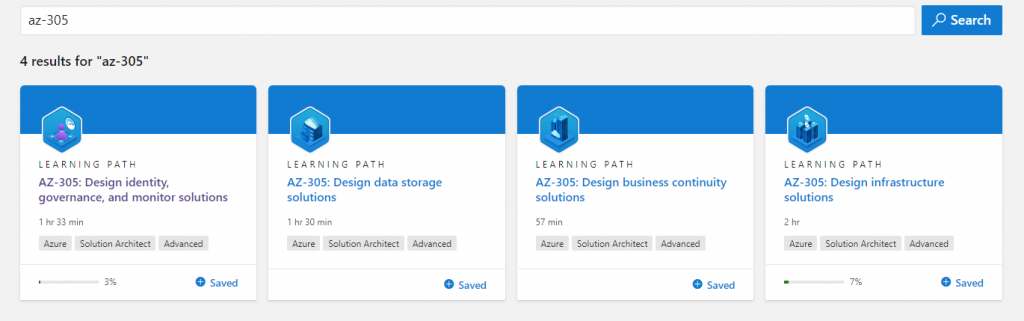
A list of helpful reference materials that will complement your four Microsoft Learn AZ-305: XXX learning paths on the official learning site are screenshotted below for your references 🙂
What is the Cloud Governance ?
The Cloud Governance is a framework that guides how end users make use of cloud services by defining and creating policies to control costs, minimize security risks, improve efficiency and accelerate deployment. It’s imperative to have good cloud governance because it’s a foundational element to your cloud practice that provides the ability to scale and be successful.
In short, the governance in Azure is one aspect of Azure Management. This includes the tasks and processes required to maintain your business applications and the resources that support them. Azure has many services and tools that work together to provide complete management.
What you can do with Azure Governance?
Enforce and audit your policies for any Azure service
Create compliant environments using Azure Blueprints, including resources, policies, and role-access controls
Ensure that you’re compliant with external regulations by using built-in compliance controls
Monitor spend and encourage accountability across your entire organization
The references below are taken from official Microsoft docs and focused on designing Azure governance solutions.
Part 1: Design a governance solution
The references below are taken from official Microsoft docs and focused on designing Governance solutions in Azure. You could also find it helpful to check the Microsoft docs and learning paths with [Tutorials] below 🙂
This collection of links is gathered with a focus on the exam objectives of the AZ-305 certification exam.
It is pretty common for every new student to be worried about exam software ⚙️ and its user expereince, in addition to being prepared for the exam. However, this is not an issue anymore.
Microsoft Learn has introduced a demo exam simulator that looks, works and feels like you are having a real Microsoft exam. This news was just announced by Microsoft Learn Blog.
I believe this is an important help for all the #cloudmarathoners and friends who are just starting their Microsoft Azure journey.
Why is it helpful?
Well, using this new exam sandbox should better prepare you for the exam experience. This should also increase your familiarity with the user interface, how to navigate between exam sections, pages and Q&A.
This simulator also shows you what actions are required to answer each of the different question types, where information about the exam is located, how to mark questions for review and how to provide comments at the end of the exam.
Important
Keep in mind that a secure browser that will be launched during a real exam will block all third-party applications running on your computer. Thus, I would strongly advise you to install and run the exam provider’s (like, Pearson VUE or any other) simulator on your local computer a day or two before the actual exam date. This will be an additional peace of mind to have in your checklist for a pleasant exam experience.
Conclusion
I sincerely wish you Good Luck ❤️ in your upcoming exam(s) !
As it was the case last year, Microsoft Ignite is back and held digitally free of charge, during Nov 2-4 🎉 🎇
Microsoft Ignite is a signature event and held virtually for a global audience across a variety of industries to experience the latest and greatest technologies. It is an event where you could get a sneak peek at new products and services that will be coming in the future.
Microsoft Ignite 2021 – Cloud Skills Challenge
Cloud Skills Challenge
This year you could choose from 12 tech challenges and select the one that is right for you. Once you complete that challenge you will earn a free Microsoft Certification exam that can be applied to your choice from a select list of options:
Azure Developer Challenge
Azure Admin Challenge
Identity + Information Protection Challenge
Teams Admin Challenge
Teams Voice Engineer Challenge
Azure Database Admin Challenge
Desktop and Device Management Challenge
Windows Server Hybrid Admin Challenge
Dynamics 365 Sales Consultant Challenge
Dynamics 365 Supply Chain Mgmt Challenge
Power Platform Developer Challenge
Security Operations Analyst Challenge
When does the challenge begin?
The listed challenges will begin on November 2, 2021 and end on November 30, 2021. You can start your registration here to join the challenge.
What happens when I complete my Cloud Skills challenge?
If you complete your challenge before it ends, one Microsoft Certification exam will be associated with your Learn profile on December 7, 2021. You will be notified via email when it becomes available.
What are the Terms and Conditions?
Check out the Official rules; including Terms and Conditions with FAQ in this web page.
Summary
That’s it friends, buckle up to complete your challenge before Nov 30, 2021 to earn new skills and receive a complementary Azure exam award 🏆.
How to get your Azure & Data Fundamentals (AZ-900 + DP-900) ⁉🤔
(Attention: you could get a free training + Azure exam voucher by the end of this article)
Microsoft Azure is one of the fastest growing cloud solution providers in the world. It has an “Azure Fundamentals” certification – an entry level cloud certification. Candidates for this exam (AZ-900) should have foundational knowledge of cloud services and how those services are provided with Microsoft Azure.
Azure Fundamentals exam is an opportunity to prove knowledge of cloud concepts, core Azure services, Azure pricing, SLA, and lifecycle, and the fundamentals of cloud security, privacy, compliance, and trust.
Are you excited to start your Azure study?
Check these absolutely free resources below and get ready for this exam then 🙂
Microsoft Virtual training events (check below 👇👇👇)
Well, next step will be the exam registration, that has a $99 cost in the USA. You could take this exam online, proctored through Pearson VUE or other exam providers.
I have a good news for you – for limited time, Microsoft generously provides complementary exam vouchers for its virtual event attendees. Thank you Microsoft for empowering people on their #cloudjourney!
Two weeks ago, I was able to clear the Azure specialty exam – “Azure IoT Developer” and get certified. More importantly, this was a good opportunity to learn about IoT technologies and services in Azure platform.
What is IoT?
An “Internet of Things” (IoT) device is typically made up of a circuit board with sensors attached that use WiFi to connect to the internet. Here are some examples of IoT devices and use cases:
A pressure sensor on a remote oil pump.
Temperature and humidity sensors in an air-conditioning unit.
An accelerometer in an elevator.
Presence sensors in a room.
The Azure Internet of Things (IoT) is a collection of Microsoft-managed cloud services that connect, monitor, and control billions of IoT assets. In simpler terms, an IoT solution is made up of one or more IoT devices that communicate with one or more back-end services hosted in the cloud.
Check out the following short video, if you never hear about applications of Internet of Things (aka, IoT).
Is there a comprehesive study guide to follow?
The short answer is YES!
As always start with simple and straight forward Microsoft Learn modules on IoT learning path. But that is not the only resource that i have used.
I personally found it very useful to check the Microsoft Tech community blog posts. The IoT sub-section has many tricks and trips and recommendations. Thus, check the following post that has very good information on exam resources:
How do I know which topics to focus on, what skills does the AZ-220 exam measure?
Where can I learn how to apply the concepts measured on the AZ-220 exam in a practical / hands-on manner?
I prefer to learn at my leisure with video content, are there any resources that cover the materials in the official docs and Microsoft Learn that I can watch?
Any thoughts on paid courses / practice exams, are there any recommendations?
It is designed for Solution Architects, Business Decision Makers, and Development teams that are interested in building IoT Solutions with Azure Services. The content is comprised of 5 video based modules that approach topics ranging from IoT device connectivity, IoT data communication strategies, use of artificial intelligence at the edge, data processing considerations for IoT data, and IoT solutioning based on the Azure IoT reference architecture.
Conclusion
Thank you for reading this post till this point.
Please, feel free to share your experience, as i am planning to keep this post up to date with your valuable contributions going forward. #keeplearning